Biorobotics Lab, CMU
Date:
I worked on controls and 3D computer vision at the Biorobotics Lab under Prof. Howie Choset, including my Bachelor’s thesis. I was involved in three projects during this time.
Project VeRT
Vertical Rapid Transport, sponsored by DARPA. Led by Dr. Beau Pollard and Prof. Howie Choset.
Project VeRT aimed at finding the research gaps and challenges in rapid transport of heavy payloads, and creating a plan to address them.
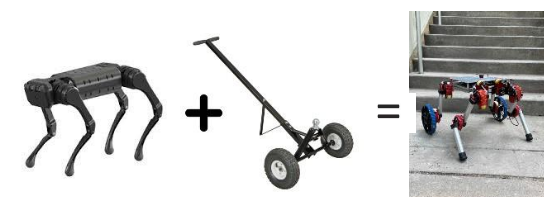
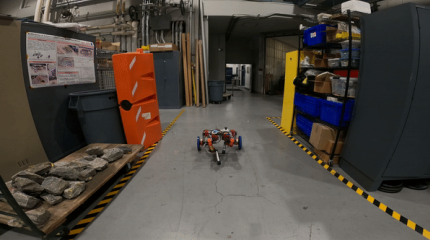
I worked on developing a prototype of a hybrid legged-wheel robot for transporting heavy payloads. The design was inspired by a hand dolly used to carry goods up stairs. I built the hardware prototype using HEBI modules and worked on Bezier curve based kinematic control, as well as MIT Cheetah inspired convex MPC control for the locomotion of the robot.
On Orbit Manipulation
Sponsored by Northrop Grumman. Led by Dr. Beau Pollard and Prof. Howie Choset.
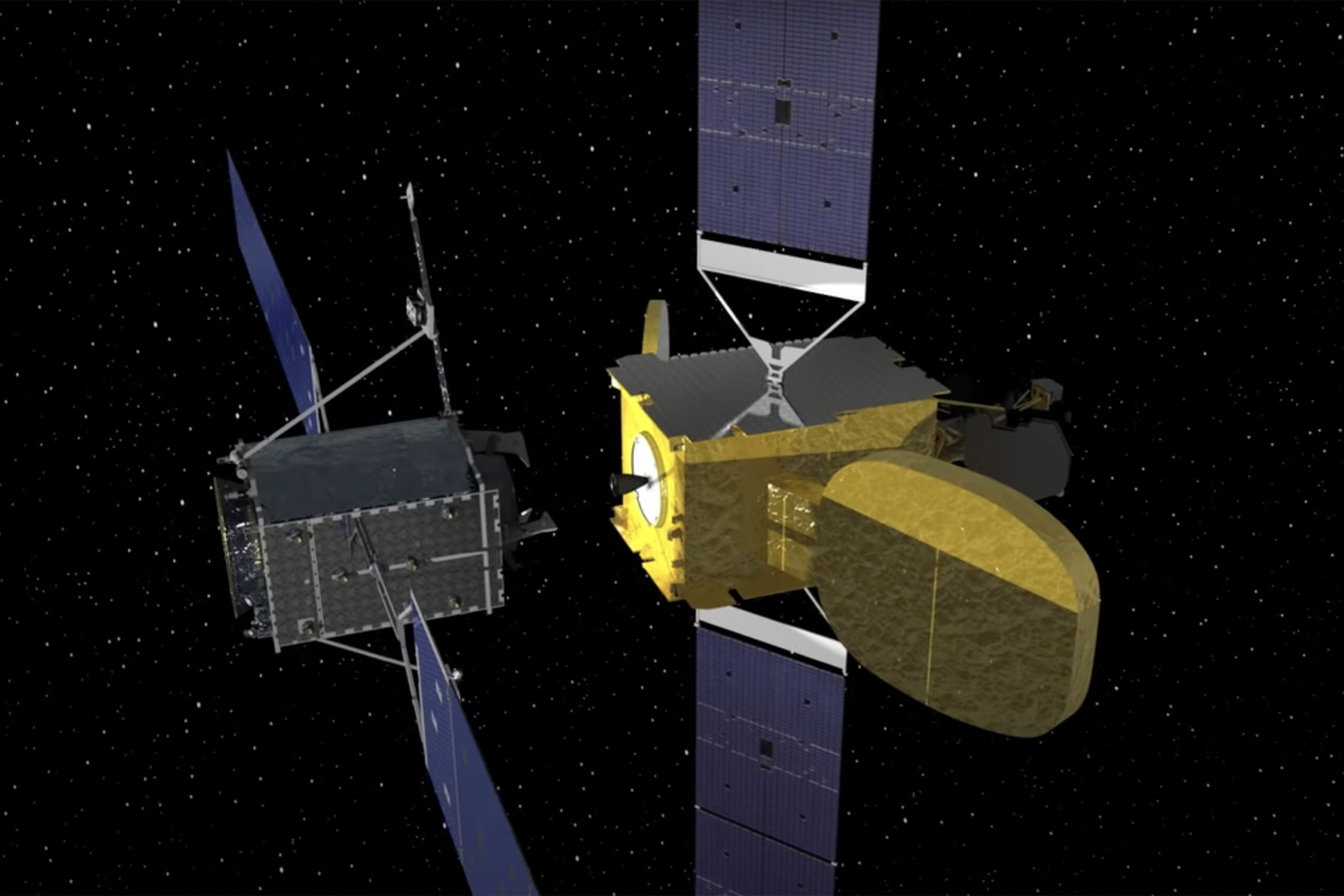
On Orbit Manipulation aimed at using robot arms to perform MEV docking on the client side in geostationary orbit.
I worked on hardware-in-the-loop validation control for peg insertion using Universal Robots arms, along with contact force estimation and impedance control.
NSF Surfside
Sponsored by NSF. Led by Prof. Robin Murphy and Prof. Howie Choset.
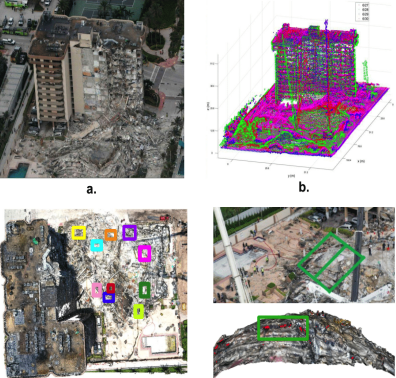
The NSF Surfside project used data from the Champlain Towers South condominium collapse at Surfside, Florida in June 2021 to reconstruct 3D point clouds of the disaster site and develop a method for detecting voids, the regions with the highest chance of concealing a survivor.
The data involved top-down RGB drone shots of the collapse site over four days. I worked on the 3D reconstruction and registration of the site using SFM techniques. The major challenges were the lack of ground truth data and the presence of dynamic objects in regions of interest. To tackle both, I developed a Hierarchical Localization + COLMAP SFM based pipeline that first estimates the camera positions in a shared coordinate space and then registers the reconstructed point clouds from different days. This eventually fed into a semi-autonomous void detection pipeline. The work from this project was published at SSRR 2022 and IROS 2023.